

November 4, 2026·7 min read
Are 48% of hairstylists really self-employed?
The quick answer
How many hairstylists are self-employed?
Nearly half. Per the U.S. Bureau of Labor Statistics, about 286,000 of the roughly 595,000 hairstylist and cosmetologist jobs in 2025 were self-employed. BLS counts jobs, so 1 person can show up twice, and it only counts unincorporated businesses. Bex reads it as proof that independent work is normal in this field.
Learn about bex+Co.® membershipYears ago, I worked at a high-end commission salon in Austin. Honestly, it was a great place to work, with a lot of really cool programs. And I still couldn’t be happy there, no matter how hard I tried.
I just didn’t like rules. If I took a vacation day, I had to make it up a week later, even when I had no clients on my book that day. I understood why the rules existed in a salon that big. They just didn’t fit me. So I started looking for a way to work for myself.
If you’ve felt that pull and wondered whether you’re the odd one out, you’re not. You’ve probably seen the number on a post somewhere: “48% of hairstylists work for themselves.”
It’s real. Let’s look at where it comes from, what it actually counts, and what it can and can’t tell you.
Where does the 48% come from?
It comes from the U.S. Bureau of Labor Statistics, in its Occupational Outlook Handbook and the employment projections data behind it. The occupation BLS measures is officially called “hairdressers, hairstylists, and cosmetologists.”
Here’s the 2025 breakdown:
| Jobs, 2025 | Share | |
|---|---|---|
| All jobs in the occupation | 595,000 | 100% |
| Self-employed | 286,000 | 48.1% |
| Wage and salary (on a payroll) | 309,000 | 51.9% |
That’s about 286,000 self-employed jobs. Almost half the field.
What does “self-employed” mean in this data?
Here are 2 details that change how you should read it.
BLS counts jobs. Its own definitions page says it “measures total employment as a count of jobs.” So a stylist who works a salon job and also takes clients on the side could show up in both columns.
It only counts the unincorporated self-employed. BLS says the national matrix “only includes the unincorporated self-employed.” If a stylist set up their business as a corporation, BLS counts them as wage and salary, even though they’re running their own business.
Put those together and the 48% is a good estimate of how common independent work is. Since it counts jobs, it can lean a little either way.
Is it growing?
BLS projects the occupation will grow to about 640,900 jobs by 2035, with self-employed jobs at about 306,100. That’s 47.8%.
So the share is expected to hold right around half the field for the next 10 years. Looking back, the Census business counts have been climbing too. More on that next.
What do the Census numbers add?
The U.S. Census Bureau counts businesses instead of jobs. Its Nonemployer Statistics count businesses with no paid employees that file taxes and bring in at least $1,000 a year. In 2023, there were 838,264 of these in the beauty salon category nationwide, compared with 84,176 beauty salons that had employees.
That count has been climbing. Census counted 750,120 in 2018, so it grew about 12% in 5 years, and it went up every year except 2020. Census changed some of its counting rules in 2022, so read the exact size of the jump with care. Even on the same rules, it grew from 823,967 in 2022 to 838,264 in 2023.
A business isn’t always a person, though. A single stylist can file more than 1, and the category includes makeup and facial services too.
Then there’s the number that sounds the scariest: about 6 in 10 1-person beauty salons took in under $25,000 in 2023. That’s 501,621 of the 838,264, counted by gross receipts. Here’s why it can mislead:
- Side gigs count. Census counts every beauty salon business with no employees that files taxes, including part-timers and people doing hair on the side of another job. Census says it “may or may not be the owner’s principal source of income.”
- It’s money in, before costs. Gross receipts are what clients paid, before rent, product or taxes. So it isn’t take-home pay, and it isn’t a measure of a full-time book either.
- The floor is $1,000. Anyone who brought in $1,000 or more in the year counts as a business, the same as a stylist with a full book.
And that share has been shrinking. In 2018, about 2 in 3 took in under $25,000 (504,118 of 750,120). Part of that drop is just prices going up. Prices rose about 21% from 2018 to 2023, per the BLS consumer price index, so $25,000 didn’t stretch as far. After adjusting for inflation, the average 1-person beauty business took in about the same in both years: about $30,300 in 2018 and $30,400 in 2023, both in 2023 dollars.
So more people run their own beauty business than 5 years ago, and the “6 in 10 under $25,000” number counts a lot of side gigs alongside full books.
If you want these numbers closer to home, I pulled the same Census counts for the Austin metro and for the Boston area.
You’ll also see a median wage of $17.21 an hour (May 2025) for this occupation. That comes from a BLS survey that leaves out the self-employed, so it describes stylists on a payroll only. Neither agency can tell you what you’d make on your own.
What are the ways to work independently?
“Self-employed” covers a lot of setups:
| Setup | What it usually looks like |
|---|---|
| Booth or chair rental | You pay a salon owner for a chair inside their salon and run your own clients |
| Salon suite | You rent a private suite in a building of suites and work on your own |
| Home studio | You work from a licensed space at home, where your state and city allow it |
| Mobile | You go to the client, like weddings and events |
Each one fits a different kind of stylist. Some people want quiet. Some want people around them. Some want the lowest cost to start. Back when I went looking, I wanted a luxury salon where I could still be my own boss, and I couldn’t find one.
What do you gain, and what do you take on?
On your own, you usually decide your prices, your hours, your services, your products, your client list and your brand. That shift from employee to owner is bigger than it sounds. Olivia, one of our colorists, still sounds a little amazed by it:
“The fact that I am now a business owner and an independent stylist is just a crazy thought.”
The other side matters just as much. Every cost is yours: space, product, booking software, card fees, insurance and education. Self-employed stylists pay self-employment tax of 15.3% on most net earnings, on top of income tax, and many make quarterly estimated payments.
Health insurance, retirement and paid time off are up to you. And when the book is light, nobody’s paying you to wait. I walked through every one of those costs in the real cost of going independent.
What worries stylists most?
The same 3 fears come up again and again. Here’s how I’d think about each one.
“Will my clients follow me?” Make 3 lists.
Your A list is the clients you know will follow you: you know their kids’ names, you did their wedding hair. Your B list is the ones who are a little loyal to the salon. Your C list is everyone you’ve seen in the past year, even once.
Then be realistic. Say 60% of them follow you. That means you only have to build 40% from scratch, and you’ve built a book before. I wrote a whole piece on will my clients follow me.
“What if the money doesn’t hold?” That’s the most common one. Nina, a stylist who spent time with us, said it on my podcast:
“One of my biggest fears, um, which is probably everyone’s, is the stability of a paycheck and money.”
The answer is a plan you make before you move: know your numbers, your costs and how many slow months you can cover.
“Will I be on my own?” That depends on the setup you pick. Some are very solo. Others put you around other stylists every day.
Questions to answer before you make a change
Grab a notebook. If you can answer these, you’re in a good place to decide:
- What do I bring in now, and what would I need to bring in to cover my costs on my own?
- Who’s on my A list, my B list and my C list?
- Did I sign anything that limits where I can work or who I can contact?
- Do I want quiet, or do I want people around me?
- Can I cover 2 or 3 slow months while I settle in?
- Who can I ask for help with taxes, insurance and setup?
So what does the 48% mean for you?
It means wanting to work for yourself is completely normal in this industry. Almost half the jobs in this field are already self-employed, and BLS expects that to hold.
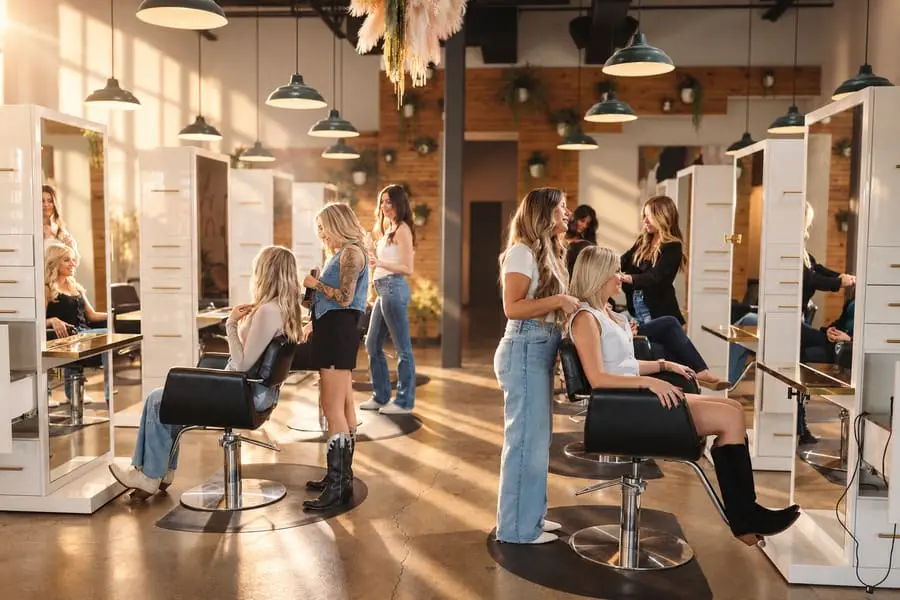
When I couldn’t find the place I was looking for, I built it in 2015. Today bex+Co.® is a Shared Workspace Salon™: one open floor where independent beauty pros each have their own chair and full workstation, set their own prices and keep their own clients, with other stylists around them. If that sounds like your kind of independent, come see the floor and ask every question on that list.
Key takeaways
- BLS says about 286,000 of roughly 595,000 hairstylist and cosmetologist jobs were self-employed in 2025, about 48%.
- BLS counts jobs (1 person can hold 2) and only unincorporated self-employment, so treat 48% as an estimate.
- The self-employed share is projected to stay about the same through 2035, at 47.8%.
- Census counted 838,264 1-person beauty salon businesses in 2023, up from 750,120 in 2018.
- Before you move, sort your clients into A, B and C lists and know your costs.
Questions people ask
What percentage of hairstylists are self-employed?
Per the U.S. Bureau of Labor Statistics, 48% of jobs for hairdressers, hairstylists and cosmetologists were self-employed in 2025, about 286,000 of roughly 595,000 jobs. BLS counts jobs, so 1 stylist can be counted twice, and it only includes unincorporated self-employment.
Is the number of self-employed hairstylists growing?
BLS projects self-employed jobs in the occupation to grow from about 286,000 in 2025 to about 306,100 in 2035. The share stays about the same, at 47.8%, because wage-and-salary jobs are projected to grow too. Looking back, the U.S. Census Bureau counted 750,120 beauty salon businesses with no employees in 2018 and 838,264 in 2023.
Do self-employed hairstylists make more money?
The BLS and Census data don’t answer that. The $17.21 median hourly wage BLS publishes covers stylists on a payroll only. Census shows about 6 in 10 1-person U.S. beauty salon businesses took in under $25,000 in 2023. That count includes many part-time and side businesses, and gross receipts are before any costs.
What are the ways to work as an independent hairstylist?
The common setups are booth or chair rental inside a salon, a salon suite, a licensed home studio, mobile work, and a Shared Workspace Salon™, where independent pros each have their own chair and workstation on one open floor.
How this page was made
Written with AI from Bex’s teaching and her course. Every number checked against its source. Open the card for what we checked and what we couldn’t.
How we verified this page
What we checked, what we couldn’t, and who read it.Checked November 4, 202615 sourcesReported with AI
The page
Who we wrote it for
A stylist who’s seen the 48% on a post and wonders about going independent.
Our lens
bex+Co.® is a Shared Workspace Salon™, and we make money when a beauty pro becomes a member. Every number on this page names its source, so you can check it yourself.
The work
How we researched it
- Built from Bex’s own words in her Glam Chats podcast and her Beauty Empire Blueprint course, opened at the transcript before use.
- Checked every number against its primary source on October 31, 2026, and the Census trend on November 4, 2026.
Who wrote it
Written with AI from Bex’s teaching and her course. Every number checked against its source.
Dates
Written October 31, 2026.
Sources
- U.S. Bureau of Labor Statistics, Occupational Outlook Handbook, Barbers, Hairstylists, and Cosmetologists, Work Environment (595,000 jobs; 48% self-employed, 2025) and Pay ($17.21 median hourly, May 2025)
- U.S. Bureau of Labor Statistics, Employment Projections, National Employment Matrix, SOC 39-5012, 2025-2035 (286,000 self-employed; 309,000 wage and salary; 2035 projections)
- U.S. Bureau of Labor Statistics, Employment Projections definitions (employment “as a count of jobs”; unincorporated self-employed only)
- U.S. Bureau of Labor Statistics, OEWS scope (the survey excludes the self-employed)
- U.S. Census Bureau, Nonemployer Statistics 2023 and County Business Patterns 2023, NAICS 812112 Beauty Salons (838,264 nonemployer; 84,176 employer establishments; receipts size classes)
- U.S. Census Bureau, Nonemployer Statistics, U.S. files 2018 to 2023, NAICS 812112 Beauty Salons (750,120 in 2018 and 838,264 in 2023; 504,118 and 501,621 under $25,000 in receipts; receipts size classes 111, 118 and 119)
- U.S. Census Bureau, About Nonemployer Statistics (no paid employees, $1,000 receipts floor, “may or may not be the owner’s principal source of income”)
- U.S. Census Bureau, Nonemployer Statistics methodology (2018 recode of sector 81 and 2022 receipts cutoffs; not recommended as a time series)
- U.S. Bureau of Labor Statistics, Consumer Price Index for All Urban Consumers, U.S. city average, all items, annual averages 2018 and 2023 (251.107 and 304.702)
- IRS, Topic no. 554, Self-employment tax
- IRS, Estimated taxes
- Bex Irvine, Glam Chats podcast, episode 21, interviewed by Stefi Lane: the commission salon, “I just didn’t like rules”, making up a vacation day, building the first bex+Co. in 2015
- Bex Irvine, Glam Chats podcast, episode 16, “How to Go Solo in the Beauty Industry”: A, B and C client lists; “say 60 percent follow you”, build the other 40%
- Nina, former bex+Co. stylist, Glam Chats podcast, episode 9
- Olivia, bex+Co. colorist, filmed interview
100+ beauty pros chose freedom. There’s room for you.
Across 7 bex+Co.® floors, running their own businesses with other pros beside them.











Your move
You were never meant to do this alone.
Tell us which salon you’d like to work in. We’ll show you which bex+Co.® salons have space for a new member and which are full, then set up a tour if you want one.